Showing posts with label Research. Show all posts

Tuesday, 15 December 2015

Title Sequence

This title sequence is from the show Teen Wolf which first aired in 2011 and was renewed for a 6th season in 2015.

Season 5 Title Sequence

Colours
From the beginning you can see that the title sequence is quite dark and only picks out certain colours. One colour I noticed a lot was red.


For example, here in the beginning, you can see it begins with the main character's eye turning red. The red has connotations of danger and also indicates Scott's (the main character) control.

They introduction of these next two main characters also have the colour red. In the above one, the string indicates the parts of the mystery that are unsolved in the season. (Some people also say the red string represents the Red String of Fate from Chinese Legend). Also, the character below has fingernails painted red. I think this is a way of indicating danger whilst also connecting the three main characters.

I found one last example of red being the dominating colour in a shot of the "Dread Doctors" (this season's main villain. The red definitely represents danger and blood here whilst also indicating that the audience should be afraid of this character.

I noticed the only time we see a lot of bright light or colour is of a shot of something that is insinuated to be to do with the "Dread Doctors." As this shot very different from all the others, it brings attention to it and the audience are more likely to take notice of it.


Sound
Throughout the titles, there is music playing. It starts off with a sound that reminds me of a car locking or that sort of thing before getting into the music. The music builds up and adds tension then it changes slightly halfway through. The change kind of speeds it up for a little bit before the music ends. Then it ends with a strange rumbling sort of noise.

There are various sound effects added along with the music. For example, in the transition above, there is a sword sound. It is quite subtle but really emphasises this character's fighting skills. It also, makes the transition more interesting.

During the shot above, there is a sound like steam escaping. This links to the previous shot to some kind of device breaking and steam escaping (it looks like it could measure temperature possibly).

Text & Other
Each shot of a character is paired with the actors' names. The main character is the first thing to appear in the opening titles and also one of the last.

I really like the bit below because it has no text. The audience just focuses on what's actually going on in the shot. The camera shakes a bit which makes the audience think it is from the POV of someone chasing these "Dread Doctors." There is also a quiet rumbling sound which adds to the whole atmosphere.

The last two things we see are the titles in a large font which takes up the whole screen. I think this looks really good because it tells you what the show is without giving away too much about what it is generally about.


The last thing we see is a shot of the villain's "lair" along with the name of the executive producer Jeff Davis. I think this is a really good ending because it gives whoever is watching a clue about the villains and themes of this particular season and it also gives the name of one of the most important people on the show.

I have also found some different versions of the opening titles.
  • Season 2 - This one shows how in earlier episodes it was different and how each seasons' opening picks out the villains.
  • The Halloween Special - This one has different music which is more fast paced. It also has more of the colour red.


Monday, 7 December 2015

Audience Feedback

The reason we are getting audience feedback in the middle of production is so we can change things accordingly without it being very complicated. We asked some people (of our target audience age) what they thought of our film. Overall, they generally rated it highly (7-8 out of 10). However, there was some things that they didn't like about it. For example, they didn't really like the part of it with the characters walking down the stairs at the beginning. The reason they didn't like it was because it is a little blurry. So, we've decided to refilm this part of our film to make it better. Overall, they liked our film but had some criticisms that we are going to address.

Tuesday, 1 December 2015

Final Cut Pro Test

This video is showing my trial run of Final Cut Pro. I used QuickTime to make a screen recording so I could show how I edited it along with the final piece. I used different techniques to edit the footage.

Sound
I begun by using the music with the footage. I'd fade it out accordingly to make it sound right and flow smoothly into the next scene. I then decided to get some music from YouTube (I used the YouTube MP3 Converter to get the music) to have at the end when the credits where shown. At the beginning, I added a wave/ocean sound effect to fill the silence and to see if the audience would guess that what they are going to watch is to do with pirates and water.

Effects
I used an effect that blacks out the screen except for a circle in the middle. I used this effect to make it look like the character was using a telescope as he is a pirate. I thought it looked really good as it still showed the majority of the shot and it showed the most important bits.

Transitions
The transitions I used were relatively simple. I just faded each scene into black (I had to add a picture of the colour black in between each scene) before moving on.

Opening
In the opening, I included a wave like sound. I did this so it wasn't too quiet and so it gave off a vibe that the rest would be to do with water or the sea. I also had the opening look like blood dripping. Originally, it was black to look like ink but I changed the colour to resemble blood which suggests there might be dark themes later on.

Ending
The ending is quite simple. I just used white credits on a black screen. I wanted music to accompany the credits but I didn't like the music provided with the credits. So, I went on to YouTube and got some from there.

Monday, 30 November 2015

Vimeo Account

We made a Vimeo account for our group to post videos related to our work. For example, we have a video called Editing Problems. We felt like it was a good idea to post the videos there as it would make the videos easily accessible and people could also comment what they think and give feedback.

Wednesday, 21 October 2015

Target Audience

Our target audience is 16-24 year olds. We have chosen this age range for a number of reasons. These include

  • Mature Themes
  • Social Media
  • Main Character
Mature Themes
Our film has some very dark themes so we think that targeting any age below sixteen could be a bad idea as the children wouldn't understand the plot and would be scared by it.

Social Media
Social media features very heavily in our film so we need to have an audience that understands it. So, we thought teenagers were best for this as that is the age group that uses social media the most. We also thought that the film shouldn't be targeted at elderly people as they'd be less likely to understand social media. Also, teenagers would be able to relate with social medias and the problems with it the most.

Main Character
Our main character is a female teenager. This means lots of the target audience either know someone like her or are like her. Also, her costume would be relatable as it consists of things lots of teenagers wear. They'd also be able to relate to the things our main character does as she is quite a stereotypical portrayal of a teenager.

Set
Part of it is set in a school which teenagers would be able to relate to and they'd be the most likely to understand the school setting and how scary it can be when someone (e.g. the panda guy) invades this safe space.

Monday, 19 October 2015

Social Media Survey

This is a survey we created to find things out about our target audience.


1.     What is your gender?   (Please circle)


Female Male                 Other


2.     What age category are you?   (Please circle)


Under 10           11 – 19             20 – 29             30 – 39             40 – 49             50 +


3.     What is your employment status?


4.     What do you do in your free time?   


5.     Do you use Social Media?   (If No, please skip to question 9)


Yes                  No                    Sometimes


6.     How much time do you spend on Social Media in a week?  (please circle)


Less than 1 hour      1-9 hours           10-19 hours          20-29 hours          30 – 39 hours      40+ hours


7.     What Social Media do you use the most?   (Please circle one or more)


Facebook         Twitter               Youtube            Snapchat          Tumblr              Instagram


Pinterest           Reddit              Vine                  Blogger            LinkedIn            Other


If Other, please state:


8.     Why do you use Social Media?


9.     Do you feel that Social Media is safe?   (please circle)


Yes                  No                   Don’t Know                   Kind of


10.  What is your general opinion on Social Media?


Thursday, 15 October 2015

Mise-en-Scene

Mise-en-Scene means 'to put in the scene' in French. Anything the audience can see on the screen is part of it. Mise-en-Scene is generally made up of a few different things;
  • Costume. This is what a character wears. It can have a big impact as costume can suggest to things that are otherwise not obvious. For example, if a character is dressed all in black it might mean that he is evil or dark. Costume can also help if you're trying to portray a specific era.
  • Location. This is where the filming takes place. It isn't saying what type of place - e.g. a library - it is saying where, e.g. a city.
  • Setting. Setting is the specific place - e.g. a school. Setting is very important as it can give clues towards the characters backgrounds, intentions, etc and change the atmosphere of a film. E.g. a graveyard setting would put the audience more on edge than a supermarket.
  • Scenery. This is about making a setting look a certain way. E.g. putting fake spider webs in a corner of a room to make it look older.
  • Props. Props are used in the set dressing and just generally add to a scene. E.g. having a knife left in room makes the audience wonder whether someone is going to get stabbed or if it is a red herring.
  • Lighting. This is how light is used on the things in the shot, for example the characters. Lighting can be used to hide things, e.g. having dim lighting stops the audience seeing all the gore of a dead body but still lets them know the character is dead. Also, it can be used to focus on certain things. For example, chiaroscuro can be used to add eeriness if a character is using a torch in the middle of the night.
  • Actors. Casting is very important. Not only do the actors have to have some talent, but they need to properly portray the character to make the audience feel the necessary emotions towards about said character. Also, good casting is key to make sure everyone turns up on time and works well together.
  • Framing. Framing is about where the characters and props are within the setting. This is important because the audience need to be able to see exactly what you want them to. Also, framing can be used to make the audience work. E.g. if there is something peculiar in the frame, e.g. a gun, the audience will think about it and wonder whether it will have any relevance to anything or if it's a red herring.
Overall, Mise-en-Scene is very important. This is because it ensures the audience feel what you want them to feel and can make things easier to understand. However, there can be difficulty in making sure that the Mise-en-Scene is correct, which the article we were given went on to explain, but there are solutions. E.g. going to charity shops to get cheaper costumes.

Wednesday, 7 October 2015

Outcomes for Audience Research

We hope to achieve five outcomes from our audience research. These are:

  1. To find out how our audience feels about gore and violence. This is we know how much of these things to include. Having too much gore or violence could make the audience feel uncomfortable. Having too little gore or violence could either confuse the audience or make the film less realistic.
  2. Work out what TAGS group enjoys thrillers, and so who we would aim the film at. This means we would be able to direct our film to attract the audience group to our film better.
  3. To find out what interests and hobbies the audience share. This means we could develop the characters and the plot to attract the audience more, but also to engage and connect with them, so that they enjoy the film a lot more.
  4. Learn what values the target audience has. For example, a film targeted at succeeded may include things such as: a man losing all his success, a successful man being kidnapped and killed. The character would often be relatable to the audience, and due to their success, the story may be made darker to give their lives a change.
  5. Find out what types of characters people like. This would help us make our main character more relatable. It would also help us decide what characters to include.

Wednesday, 30 September 2015

The Sixth Sense

- written and directed by M. Night Shyamalan
- starring Bruce Willis and Haley Joel Osment
- released August 1999
- supernatural thriller

The sixth sense.jpg

The film has many thriller conventions, for example it begins with someone getting revenge. An old patient comes and shoots the Dr. Malcolm. It also definitely has psychological themes throughout. The principle of concealment is also used to hide the fact that Malcolm died.

I SEE DEAD PEOPLE SCENE

The big plot twist is that the main character is actually a ghost. When he got shot at the start of the film, he actually died. However, there were clues for the audience. For example, after the audience finds out about Cole being able to see dead people, the shot of Malcolm lasts quite a considerably long time. Some people have interpreted this as a way of making the audience work to notice that Malcolm is actually dead. Another thing that is used in the film is eerie music. It really helps to add to the tenseness of the situation and puts the audience on edge.

Sunday, 27 September 2015

Grand Piano

Grand Piano Trailer Analysis


Grand Piano is a good example of a thriller. The trailer has many of the conventions a thriller generically has.


1. The above screenshot is paired with the dialogue "Tom. You're alive!" This is shown very early in the trailer and makes the audience question why Tom (the main character) would not be alive. It also links to the rest of the film where we as an audience will be shocked that Tom is still living. 


2. This screenshot shows Tom's sheet music which he is reading whilst on stage performing. The red writing is obviously out of place and visibly shocks Tom. We can tell from this and other clues he is quite a world weary character as he hasn't performed in years. The red has connotations of blood and grabs the audience's attention. This also uses the 'whodunit technique' as we don't know who wrote this.


3. There is classical music playing throughout the majority of the trailer. This really sets the scene for the rest of the film as it is based around a concert. Also, the music has a bit of a creepy tone to it which makes the audience wonder if there is something sinister happening.


4. Here we find out whoever is after Tom is a psychotic individual, some sort of an assassin. We also find out this person is in the audience by seeing things from his POV.


5. ECUs are used to show how incredibly uncomfortable Tom is. Dramatic angles are also used to show different things or to make things more interesting


6. This two screenshots are used one after another as a clever way of showing this woman has had her throat slit. This use of parallel editing is really clever and interesting and really gets the audience thinking,


Saturday, 26 September 2015

Shutter Island Class Analysis


Shutter Island Class Analysis
During class we looked at the opening of the film Shutter Island.


We focused on four main areas: Camera work, editing, mise en scene and sound.


A few things we noticed for camera work were:
1. The ECU on Teddy's police badge. Is he really a policeman? Should we question him?
2. Whilst the truck is driving up to the gates, we see from Teddy's POV. Even though we are unsure whether or not to trust Teddy, seeing from his point of view makes the audience sympathise with him as we are in the same position as him - seeing the strange hospital for the first time.
3. One last thing that was noticed is the long shot of Teddy and his new partner. It means we can get a good look at both of them and leads us on to the question; "Who can we trust?"


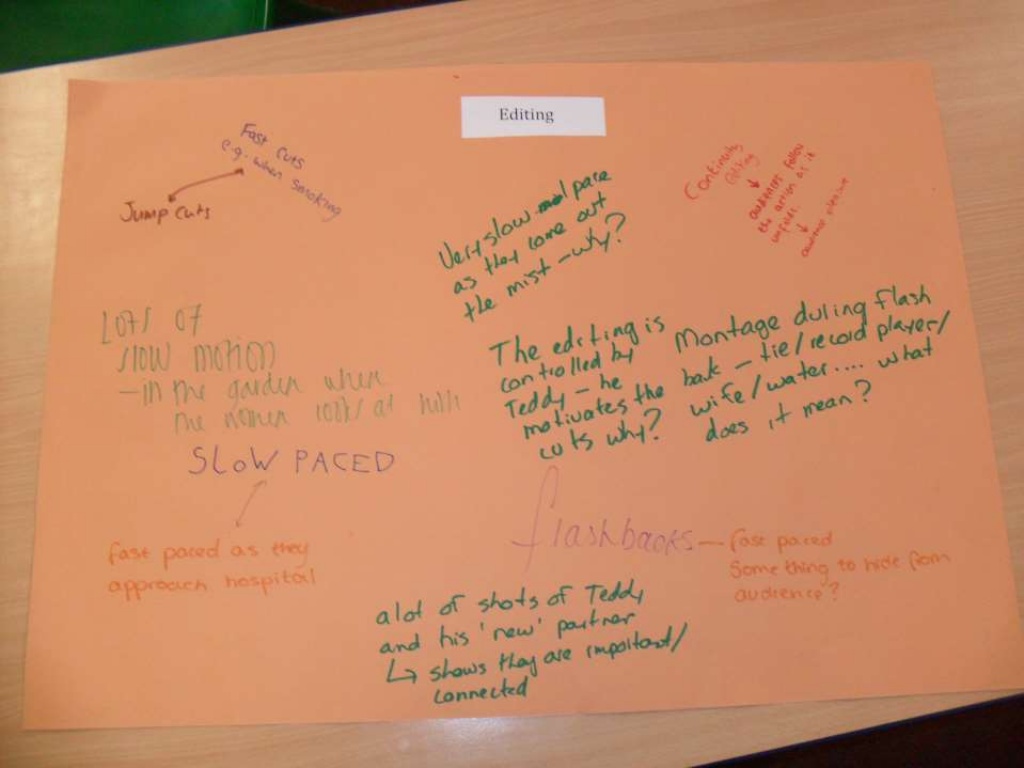
A few things we noticed for editing were:
1. There was a lot of slow motion. One example of this was when the creepy woman looked at Teddy in the garden. This makes the audience focus on her more and really try to figure her out.
2. The flashback was extremely fast paced. It cut from shot to shot very quickly. This is possibly to confuse the audience or perhaps a form of narrative retardation. The quickness is so the audience doesn't have time to see everything that is going on. They can't understand the whole flashback.
3. There is a montage during the flashback. It includes a tie, a record player, Teddy's wife and random water. What is the relevance of all these things? The audience has to work to figure it out.


A few things we noticed for mise en scene were:
1. There is obviously set and costume styling relating to the 1950s. You can tell from all the costumes and set roughly when the film is set in. It really makes you believe the film as it feels accurate and as it is set in the past you question; could this have happened?
2. Ward C was very dark and colourless compared to the other wards. This links to the fact that it is off limits. It also foreshadows the dark horrors held inside Ward C and makes the audience wonder if (and when) Teddy will pay Ward C a visit.


A few things we noticed for sound were:
1. Teddy says "Can't stomach the water." This foreshadows the drowning of his water later on in the film and makes the audience wonder why he doesn't like the water. This links to the random appearance of water during his flashback.
2.There is eerie music at the beginning which really makes the audience uncomfortable. There is also loud music when Teddy is going to the hospital which builds and gets louder. This makes the audience think something bad is going to happen to Teddy despite nothing bad actually happening then.
3. When Teddy looks at a creepy woman in the garden, there is silence. The creepy music stops as he stares at her. This is to make the audience focus on her more rather than on anything else (e.g. the music). This links to the slow motion when he looks at her. It makes the audience focus on her so much that they miss other details. She turns out, however, to be a red herring.


Lucky Number Slevin


Saturday, 5 September 2015

The Hobbit

The Hobbit

https://en.wikipedia.org/wiki/The_Hobbit_(film_series)
https://en.wikipedia.org/wiki/The_Hobbit:_An_Unexpected_Journey


Institutions

Peter Jackson - https://en.wikipedia.org/wiki/The_Hobbit_(film_series)
King Kong, The Lovely Bones - https://en.wikipedia.org/wiki/Peter_Jackson
Peter Jackson, Fran Walsh, Zane Weiner, Carolynne Cunningham - https://en.wikipedia.org/wiki/The_Hobbit_(film_series)
The Frighteners, Heavenly Creatures - https://en.wikipedia.org/wiki/Peter_Jackson#Filmography
Inception, Harry Potter and the Goblet of Fire - https://en.wikipedia.org/wiki/Warner_Bros.
$303,003,568 - http://www.boxofficemojo.com/movies/?id=hobbit.htm

Audience

http://scifi.stackexchange.com/questions/77486/should-i-watch-the-hobbit-trilogy-before-the-lotr-trilogy
PG-13 for extended sequences of intense fantasy action violence, and frightening images. - http://parentpreviews.com/movie-reviews/film-info/hobbit-an-unexpected-journey12, moderate violence - http://www.bbfc.co.uk/releases/hobbit-unexpected-journey-2012-2 
8.0 - http://www.imdb.com/title/tt0903624/
Charming, spectacular, technically audacious… in short, everything you expect from a Peter Jackson movie. A feeling of familiarity does take hold in places, but this is an epically entertaining first course - http://www.metacritic.com/movie/the-hobbit-an-unexpected-journey

Genre and Conventions


12A, AdventureFantasy - http://www.imdb.com/title/tt0903624/
Fantasy is a genre of fiction that commonly uses magic and other supernatural phenomena as a primary plot element, theme, or setting. Many works within the genre take place in imaginary worlds where magic and magical creatures are common. Fantasy is generally distinguished from the genres of science fiction and horror by the expectation that it steers clear of scientific and macabre themes, respectively, though there is a great deal of overlap between the three, all of which are subgenres of speculative fiction. - https://en.wikipedia.org/wiki/FantasyTime Bandits, In a Better World - http://filmschoolrejects.com/features/13-movies-to-watch-after-youve-seen-the-hobbit-the-desolation-of-smaug.php

Representation

In The Hobbit, Bilbo Baggins, a hobbit in comfortable middle age at 50 years old, was hired in spite of himself as a "burglar" by the wizard Gandalf and 13 Dwarves led by their king Thorin Oakenshield on a quest to reclaim the Lonely Mountain and its treasure from the dragon Smaug. - https://en.wikipedia.org/wiki/Bilbo_Baggins
https://en.wikipedia.org/wiki/Middle-earth


"Even the smallest person can change the course of the future."  - https://answers.yahoo.com/question/index?qid=20100828012853AAfs83I

Friday, 4 September 2015

12 Years a Slave

12 Years a Slave


https://en.wikipedia.org/wiki/12_Years_a_Slave_(film)


Institutions

Steve Mcqueen - https://en.wikipedia.org/wiki/12_Years_a_Slave_(film)
Hunger, Shame - https://en.wikipedia.org/wiki/Steve_McQueen_(director)
Brad Pitt, Dede Gardner, Jeremy Kleiner, Bill Pohlad, Steve McQueen, Arnon Milchan, Anthony Katagas - https://en.wikipedia.org/wiki/12_Years_a_Slave_(film)
The Departed - https://en.wikipedia.org/wiki/Brad_Pitt
Black Swan, 127 Hours - https://en.wikipedia.org/wiki/Fox_Searchlight_Pictures
Divergent, That Awkward Moment - https://en.wikipedia.org/wiki/Entertainment_One
American Pie, Twilight - https://en.wikipedia.org/wiki/Summit_Entertainment
$56,671,993 - http://www.boxofficemojo.com/movies/?id=twelveyearsaslave.htm


Audience


http://www.slate.com/blogs/browbeat/2014/01/31/_12_years_a_slave_ad_declares_that_it_s_time_to_see_the_movie_why.html
http://www.theguardian.com/film/2014/jan/14/12-years-a-slave-box-office-performance

15, strong violence, injury detail, sex, nudity and racist terms - http://bbfc.co.uk/releases/12-years-slave-2013
R for violence/cruelty, some nudity and brief sexuality - http://parentpreviews.com/movie-reviews/film-info/12-years-a-slave
And the film captures this. And it is very moving, and is very uncomfortable to the point where it is almost unbearable. But you and I just have to sit and watch it. As far as history is concerned, many had to live it. As far as the present is concerned, many still do. And yet despite this evil tale that the film tells, one cannot leave without realizing that in the midst of it, dare I say, the point of it, is that there is a relentless and unfailing beauty in the story being told; in the history being shown. And one that no amount of evil can take away - http://thoughtcatalog.com/kovie-biakolo/2014/03/why-everyone-should-see-12-years-a-slave/

Intense, unflinching, bold in its simplicity and radical in its use of image, sound and staging, 12 Years a Slave in many ways is the defining epic so many have longed for to examine — if not cauterize — America’s primal wound. - http://www.metacritic.com/movie/12-years-a-slave


Genre and Conventions

15  |   |  BiographyDramaHistory - http://www.imdb.com/title/tt2024544/
An essential element of historical fiction is a setting located in a temporal past. In this setting, historical fiction frequently portrays the manners and social conditions of the persons or times presented in the story and pays attention to other period details. - https://en.wikipedia.org/wiki/Historical_fiction
Solomon Northup's Odyssey, Hunger - http://filmschoolrejects.com/features/12-movies-to-watch-after-youve-seen-12-years-a-slave.php

Representation

https://en.wikipedia.org/wiki/Solomon_Northup
Based on an incredible true story of one man's fight for survival and freedom. In the pre-Civil War United States, Solomon Northup (Chiwetel Ejiofor), a free black man from upstate New York, is abducted and sold into slavery - http://www.imdb.com/title/tt2024544/plotsummary
The film tells the horrific true story of free black man Solomon Northup, who was drugged, kidnapped and sold into slavery in 1850s America to suffer years of abuse. - http://www.mirror.co.uk/news/real-life-stories/12-years-slave-true-story-2989533

Wednesday, 2 September 2015

Shutter Island

Shutter Island

https://en.wikipedia.org/wiki/Shutter_Island_(film)


Institutions

The Departed, Hugo - https://en.wikipedia.org/wiki/Martin_Scorsese
Alison Scott, Bradley J. Fischer, Mike Medavoy, Arnold W. Messer - https://en.wikipedia.org/wiki/Shutter_Island_(film)
Holes, Black Swan - https://en.wikipedia.org/wiki/Mike_Medavoy
Jack Ryan, Indiana Jones - https://en.wikipedia.org/wiki/Paramount_Pictures
$128,012,934 - http://www.boxofficemojo.com/movies/?id=shutterisland.htm

Audience

https://www.commonsensemedia.org/movie-reviews/shutter-island
15, strong language, bloody injury, disturbing images - http://www.bbfc.co.uk/releases/shutter-island-film
R for disturbing violent content, language and some nudity - http://parentpreviews.com/movie-reviews/film-info/shutter-island


8.1 - http://www.imdb.com/title/tt1130884/
DiCaprio, in his most haunting and emotionally complex performance yet, is the vessel Scorsese uses to lead us through the film’s laby­rinth. - http://www.metacritic.com/movie/shutter-island

Genre and Conventions

15, MysteryThriller - http://www.imdb.com/title/tt1130884/
A thriller provides the sudden rush of excitement, and exhilaration that drive the narrative, sometimes subtly with peaks and lulls, sometimes at a constant, breakneck pace. It keeps the audience on the "edge of their seats", akin to the sensation of hanging from a cliff, as the plot builds towards a climaxLiterary devices such as red herringsplot twists, and cliffhangers are used extensively. A thriller is usually a villain-driven plot, whereby he or she presents obstacles that the protagonist must overcome. - https://en.wikipedia.org/wiki/Thriller_(genre)
Secret Window, Memento - http://itcher.com/mag/good-movies-like-shutter-island/

Representation

https://stefansmovies.wordpress.com/2013/04/10/the-truth-about-shutter-island/
hutter Island is set in the 1950s. During that era, severe mental disturbances were often dealt with physically. In America, more than 40,000 patients were lobotomised over a 30-year period. - http://www.theguardian.com/film/filmblog/2010/jul/29/shutter-island-ending
http://screenrant.com/shutter-island-spoilers-discussion-vic-46052/